Do Dermal Fillers Really Disappear? What Happens to Filler Over Time?
One of the questions I hear most often about dermal fillers is, “What happens to the filler once its effect wears off?” Many people are familiar with timelines such as six months, one year or 18 months. But the story is more nuanced than a number on a calendar.
In my practice, I explain that there are two different things to consider: how long the visible effect lasts and how long the filler material remains detectable in the tissues. These are not necessarily the same. The type of filler, treatment area, tissue movement and individual response can all influence what happens over time.
Do Dermal Fillers Completely Disappear?
Most temporary fillers are gradually broken down and absorbed by the body. Hyaluronic acid (HA), one of the most commonly used filler materials, is naturally present in the body and is formulated in different ways for aesthetic use.
The FDA notes that the effects of most temporary fillers are not permanent because the body eventually breaks down and absorbs the material. However, the expected duration varies according to the filler material and the area treated.
This is where the phrase “the filler has worn off” can be misleading.
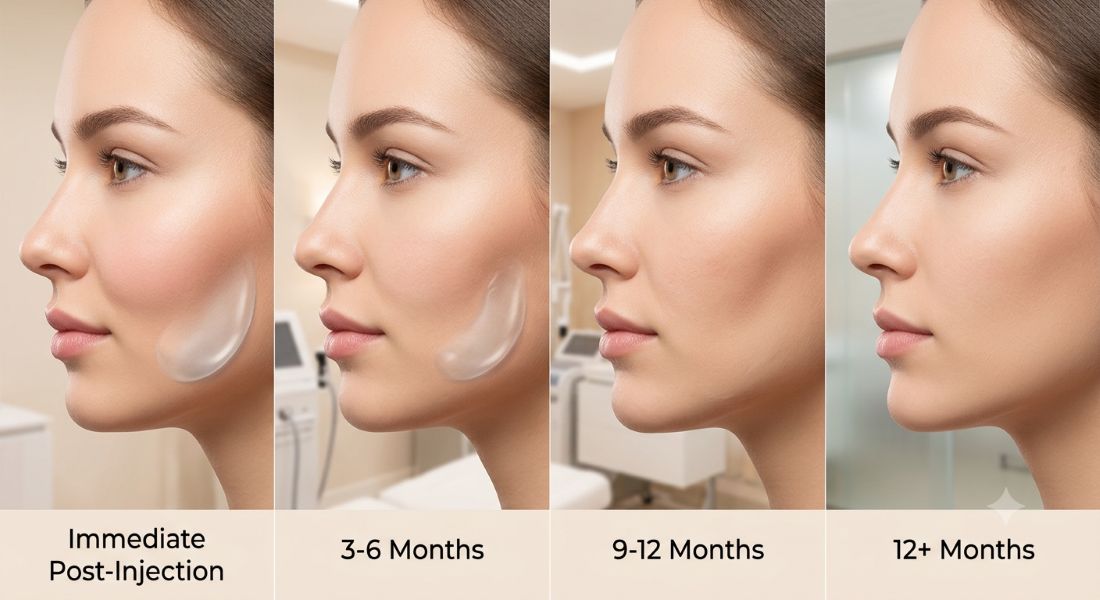
A person may notice that the original fullness or contour has reduced even though small amounts of filler may still be detectable within the tissue. In other words:
Filler material → tissue response → visible effect → gradual change over time
These stages do not always occur at exactly the same pace.
How Long Does Hyaluronic Acid Filler Last?
There is no universal timeline for every HA filler.
The FDA lists an approximate duration of six to 12 months for some HA products, while approved filler products can have different expected durations depending on their formulation and intended use.
More recent research has also made the picture more interesting. A 2026 systematic review found that HA filler durability varies with factors such as product technology, tissue mobility and the anatomical area treated.
This means I would not use a single number to predict how long a particular patient's filler will remain effective.
The cheeks, lips and areas around the mouth, for example, experience different degrees of movement. The properties of the product also matter.
What Happens When Filler Wears Off?
As the filler gradually loses volume or its visible effect decreases, the treated area generally moves back towards its pre-treatment appearance.
However, natural ageing continues during this period. Skin elasticity, facial fat distribution, bone structure and changes in soft tissue do not remain exactly the same.
So if someone had Lip Fillers, for example, the lips may gradually lose the additional fullness as the filler effect decreases. That does not necessarily mean the lips have suddenly become “worse.” The face has simply continued to change naturally while the filler effect has changed.
This distinction is important when assessing whether another treatment is appropriate.
Can Filler Remain in the Face After Two Years?
This is where newer imaging research has challenged the simple idea that all HA filler disappears within a few months.
A 2024 review of 33 MRI studies found detectable HA in the mid-face in all studied patients at two years, with some patients showing detectable material several years after injection. The authors also noted that larger studies are needed to understand long-term persistence fully.
Another MRI study found that HA persisted in some facial areas for more than two years, while degradation occurred more quickly in another treated area.
These findings do not mean every filler remains for years, nor do they mean that the original visible effect continues unchanged for that entire period.
They show why filler persistence and clinical effect should be considered separately.
Why Does Filler Duration Differ Between People?
Several factors can influence how long a filler remains clinically noticeable.
1. The filler material
Different materials have different properties. HA, calcium hydroxylapatite and poly-L-lactic acid do not behave identically in tissue, and their expected duration differs.
2. The treatment area
Areas with frequent facial movement may behave differently from relatively stable areas. Tissue depth and anatomy also influence how filler is distributed.
3. Product formulation
HA fillers are not all identical. Cross-linking, particle characteristics and other manufacturing factors can affect their behaviour and durability.
4. Individual biology
The body's tissue response varies from person to person. Metabolism, tissue characteristics and natural ageing can all influence the clinical appearance over time.
This is why a cosmetic surgeon in Kolkata should assess the individual treatment area rather than rely only on a general internet timeline.
Does More Filler Mean It Will Last Longer?
Not necessarily.
Increasing the amount of filler does not provide a simple guarantee of longer-lasting results. Treatment planning involves considering the anatomy, product characteristics, intended correction and how the area moves.
I prefer to look at the underlying reason for volume loss before deciding whether additional filler is appropriate. This is especially relevant when someone has previously received fillers and is considering another treatment.
The aim should be to understand what has changed rather than automatically adding more volume.
What Should You Know Before Getting Dermal Fillers?
Before treatment, I recommend discussing four practical points with your doctor:
- Which filler material is being considered?
- What is its expected duration for the specific treatment area?
- What temporary effects can occur after injection?
- What should be done if the appearance changes over time?
This conversation is particularly useful because dermal fillers are medical procedures, not simply cosmetic products. The FDA also recommends discussing the specific product, its approved uses and potential risks with a qualified healthcare provider.
If you are researching Lip Fillers or other facial filler treatments, understanding the product and the anatomy being treated is more useful than focusing only on how many months the result is expected to last.
Understanding Filler Beyond the Timeline
The idea that filler simply “disappears” on a particular date is an oversimplification.
Some temporary fillers are gradually absorbed, but the visible effect can change before all detectable material has necessarily disappeared. Research using imaging has shown that HA can sometimes remain detectable considerably longer than traditional treatment timelines suggest.
For me, the important question is not only “How long will my filler last?” It is also “What is happening to the filler and my facial tissues over time?”
That understanding helps patients approach treatment with realistic expectations and recognise why individual assessment matters.
Frequently Asked Questions
1. Do dermal fillers completely disappear?
Most temporary fillers are gradually broken down and absorbed by the body. However, research suggests that some HA fillers can remain detectable in tissue longer than their visible clinical effect.
2. How long does hyaluronic acid filler last?
The duration varies by product, treatment area and individual factors. Some FDA-approved HA fillers have an expected effect of around six to 12 months, while other products may last longer.
3. Does filler remain in the face after two years?
It can. Imaging studies have detected HA filler beyond two years in some patients and treatment areas. This does not mean that the original visible effect remains unchanged for that entire period.
4. What happens when dermal fillers wear off?
The visible fullness or contour created by the filler gradually decreases. Natural ageing continues during this time, so the face may not look exactly as it did before the original treatment.
5. Why does filler duration differ between people?
Product formulation, treatment area, tissue movement, injection depth and individual biological factors can all influence filler longevity. A personalised assessment is therefore more useful than relying on a fixed timeline.
About Dr. V S Rathore
Dr. V S Rathore
M.B.B.S. (Hons) MS, M. Ch
Plastic, Cosmetic & Reconstructive Surgeon
Medical Disclaimer:
This content is for general educational purposes only and does not constitute medical advice. Individual results vary. Please consult your treating doctor for a personalised assessment before making any decisions about cosmetic or surgical treatment.