Does Stem Cell Therapy Really Work for Hair Regrowth?
Receding hairline is a concern for millions worldwide. The agitation runs deeper than appearance. If oil treatments, medicated shampoos, and all other OTC solutions have slowed things down but never reversed the condition. Considering proper hair regrowth treatment before your hair transplant options shrink is the wisest decision.
Unlike traditional treatments for hair loss, stem cell therapy is a new-age, non-invasive, regenerative treatment designed to revive follicles that are still alive but have stopped functioning properly.
Clinical use over the past several years has shown remarkable results for people dealing with early to moderate thinning — without surgery, incisions, and minimal downtime.
This blog breaks down exactly how it works, what results actually look like, and who it's genuinely suited for.
How Stem Cell Therapy Works on Hair Follicles
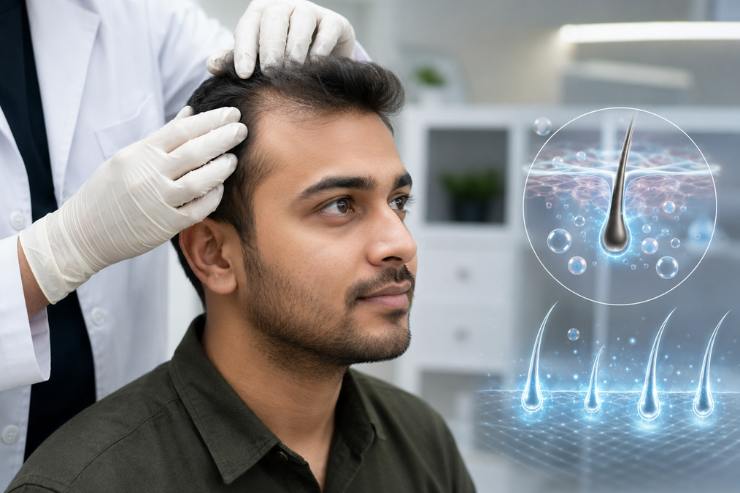
Every strand of hair grows from a follicle, and thinning happens when follicles shrink and lose their ability to produce thick, healthy strands. Stem cell therapy works by targeting this exact problem.
The treatment uses growth factors and signalling molecules to:
- Reduce inflammation in the scalp that interferes with healthy hair cycles
- Improve blood supply to the follicle, restoring nutrient delivery
- Reactivate follicles that have become dormant but are not yet dead
- Extend the growth phase of the hair cycle, reducing premature shedding
The key distinction is that this treatment revives existing follicles rather than creating new ones. This is what makes it powerful for early and moderate thinning, and why it isn't a substitute for a transplant in areas that are completely bald.
Why It's Considered a Breakthrough in Hair Restoration
Stem cell therapy has gained traction because it offers:
- No surgery, no scarring — there are no incisions, stitches, or strip removal involved
- Minimal downtime — most people resume normal routines within a day or two
- Uses the body's own cells — the treatment is autologous, meaning it's derived from the patient's own tissue, which lowers the risk of rejection or adverse reaction
- Targets the cause, not just the symptom — instead of masking hair fall, it works on follicle health directly
This combination of safety, minimal invasiveness, and biological effectiveness is why clinics increasingly position it as a serious option rather than an experimental add-on.
What Results Actually Look Like
Expectations matter, and results build gradually rather than overnight.
- Weeks 1–4: A brief shedding phase can occur as weaker hair is pushed out to make room for stronger regrowth
- Months 2–4: Hair fall visibly reduces, and existing strands begin appearing thicker and less brittle
- Months 6–12: Noticeable improvement in density, particularly in areas with early to moderate thinning
Results vary based on the extent of thinning and individual scalp health, which is why progress is typically assessed through scheduled clinical follow-ups & observation.
Stem Cell Therapy vs PRP vs Hair Transplant
This is one of the most common concerns among most individuals. Here’s what you need to understand about the treatments:
- PRP (Platelet-Rich Plasma): A milder, maintenance-focused treatment that supports follicle health but requires periodic efforts.
- Stem Cell Therapy for Hair Regrowth: A stronger regenerative treatment aimed at reviving shrinking or dormant follicles.
- Hair Transplant: A surgical solution for areas with no active follicles left, offering permanent redistribution of hair.
Many patients use stem cell therapy either as a standalone treatment for early thinning, or alongside a transplant to strengthen surrounding hair and support the transplanted grafts.
Who Is an Ideal Candidate for Stem Cell Therapy for Hair Regrowth?
Stem cell therapy works best for:
- Early to moderate pattern thinning
- Diffuse hair fall linked to stress, hormonal shifts, or nutritional gaps
- Patients looking to strengthen results after a hair transplant
- Those who want to avoid surgery but need more than what topical treatments offer
It is not the right fit for scalp areas that are fully bald with no follicle activity, or extensive scarring where no biological base remains to regenerate.
Safety and What to Expect
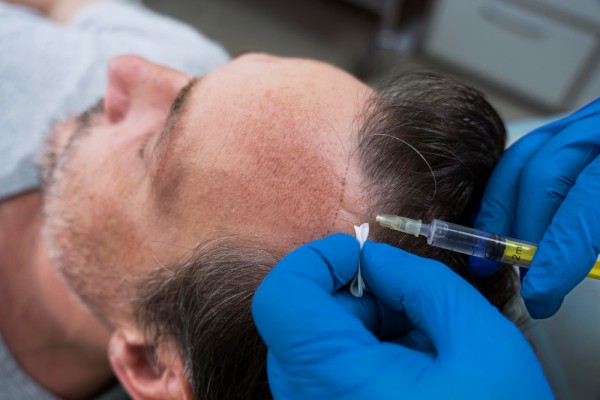
Because the treatment uses the patient's own cells, safety is one of its strongest advantages. The process typically involves a minor extraction (often through fat extraction), followed by processing to isolate the stem cells, which are then reintroduced into the scalp.
Most patients experience mild soreness or swelling at the extraction site for a day or two, with no major recovery period required.
Find the Right Treatment for Your Hair Loss
Stem cell therapy has gained popularity as one of the most advanced, non-invasive and regenerative treatment for hair regrowth today.
But, one must never forget,
- Stem cell therapy can stimulate hair growth and is not an ideal solution for complete baldness.
- It is mostly effective for early to moderate hair thinning where follicles are still active.
- No single treatment works the same way for everyone.
- The right choice depends on the level of thinning & how the scalp responds
If thinning hair has left you concerned & confused about deciding between stem cell therapy, PRP, or a hair transplant, consult our expert hair transplant surgeon in Kolkata to find out whether stem cell therapy for hair regrowth is suitable for your scalp and desired density.
Book your consultation today and take the first step toward restoring hair at your own strength!
Frequently Asked Questions
Does stem cell therapy permanently regrow hair?
Stem cell therapy does not create new hair permanently on its own, but it significantly improves the health and thickness of existing, weakened follicles, with results that can last long-term when combined with proper scalp care.
How many sessions of stem cell therapy are needed for visible results?
Most patients require 1 to 3 sessions spaced a few months apart, with visible improvement in hair fall reduction typically appearing within 3 to 4 months.
Is stem cell therapy for hair regrowth painful?
The procedure involves only mild discomfort during the extraction process, with most patients reporting soreness similar to a minor bruise for a day or two afterward.
What is the difference between stem cell therapy and PRP for hair loss?
Stem cell therapy is a stronger, more regenerative treatment that revives dormant follicles, while PRP is a milder maintenance treatment that supports already-active follicles.
Can stem cell therapy be combined with a hair transplant?
Yes, stem cell therapy is often used alongside a hair transplant to strengthen surrounding hair and support graft survival, making it an effective complementary treatment rather than a replacement.
Who should not opt for stem cell therapy?
Patients with completely bald areas with no active follicles or extensive scalp scarring are not ideal candidates, as the treatment works by reviving existing follicles rather than creating new ones.